Dr. Kay Holekamp of Michigan State University announces a wonderful field school opportunity studying the behavior of Kenyan hyenas! Even for students with a primary interest in primates, hyenas are fascinating animals and the field school draws on similar behavioral observation techniques as does primate research. Dr. Holekamp is looking for undergraduates between their junior and senior year. Please print out the flyer and announce to your students! (Application info can be found on the flyer.)
There are 2 projects that will be available for participation during summer, 2012:
1. Spotted hyenas and ecosystem health. The spotted hyena is the most abundant and wide-ranging large carnivore in Africa. In addition to their plasticity in regard to habitat choice, hyenas are extremely adaptable carnivores that can survive by scavenging or hunting large and medium-sized herbivores. Where many other mammalian species occupying African ecosystems cannot readily adapt to changing environmental conditions, the spotted hyena is able to thrive. Using the spotted hyena as an indicator for changing African ecosystems, we may be able to predict changes and modify conservation practices before it is too late.
*** Work this summer will involve running transects to document space use patterns of sympatric mammal, monitoring of hyena space-use via radio telemetry, and daily monitoring of hyena behavior and demography.
2. Maternal strategies and offspring development. The spotted hyena displays a protracted period of development characterized by extensive maternal care and marked by distinct developmental milestones. This project explores first, how maternal behavior and physiology vary with social rank and degree of human disturbance and second, what the consequences of anthropogenic disturbance may be for the development of spotted hyena cubs. Previous research indicates that adult females in areas of high disturbance show higher stress levels and lower attendance at communal dens where cubs are reared.
*** Work this summer will include collection of focal and all-occurrence behavioral data, organization and analysis of demographic and hormonal data, and development of field experiments to measure temperament/personality.
Travel costs (airline tickets, room, board, Kenyan visa, etc.) will be covered by NSF funds, and students will also receive a stipend of $2500.
Showing posts with label fieldwork opportunities. Show all posts
Showing posts with label fieldwork opportunities. Show all posts
Thursday, October 20, 2011
Monday, September 12, 2011
DANTA Winter Field Course
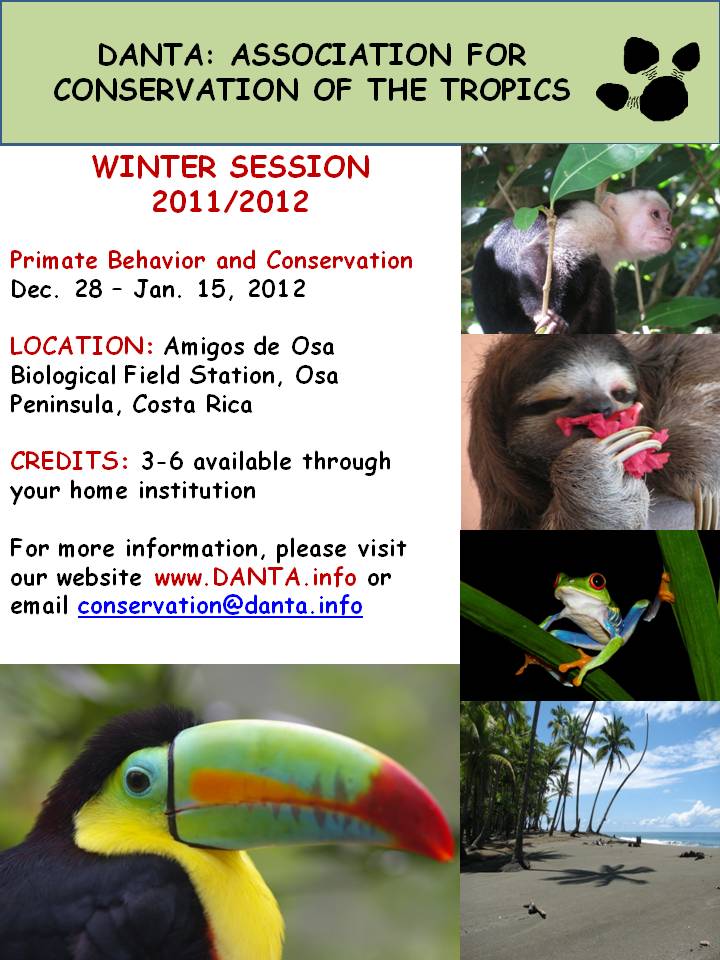
Kim Dingess, Director of DANTA, the Association for Conservation of the Tropics, announces the Winter 2011-2012 field courses. Much of DANTA's advertising is word of mouth so please circulate this announcement:

Danta: Association for Conservation of the Tropics is pleased to announce its winter 2011-2012 field course in tropical biology. Our courses are intended for undergraduates or early graduate level students who have a keen interest in tropical biology and conservation, but have little or no experience of working in a tropical environment. Participants may enroll on either a credit or non-credit basis.
Courses will be held in Costa Rica’s spectacular Osa Peninsula. As one of the largest tracts of rain forest north of the Amazon, this area is renowned for high animal and plant diversity. It is one of only a few places in Costa Rica that has jaguar, puma, sea turtles and four species of monkey (mantled howler monkey, black-handed spider monkey, white-faced capuchin and squirrel monkey). It is also home to nearly 4,000 plant species, including trees more than 200 feet tall. All students participating in our programs will have opportunity to be involved in applied conservation (i.e., sea turtle monitoring and reforestation) and community service.
Winter Session 2011-2012
Primate Behavior and Conservation (December 28 – January 15, 2012). Instructors: Kimberly Dingess, Anthropology, Indiana University, Bloomington; Marni LaFleur, Department of Anthropology, University of Colorado, Boulder and Dr. Klaus Zuberbühler, Department of Psychology, University of St. Andrews, Scotland.
For more information, please visit our website at www.DANTA.info or email conservation@danta.info.
Hope to see you in Costa Rica!
Danta: Association for Conservation of the Tropics is pleased to announce its winter 2011-2012 field course in tropical biology. Our courses are intended for undergraduates or early graduate level students who have a keen interest in tropical biology and conservation, but have little or no experience of working in a tropical environment. Participants may enroll on either a credit or non-credit basis.
Courses will be held in Costa Rica’s spectacular Osa Peninsula. As one of the largest tracts of rain forest north of the Amazon, this area is renowned for high animal and plant diversity. It is one of only a few places in Costa Rica that has jaguar, puma, sea turtles and four species of monkey (mantled howler monkey, black-handed spider monkey, white-faced capuchin and squirrel monkey). It is also home to nearly 4,000 plant species, including trees more than 200 feet tall. All students participating in our programs will have opportunity to be involved in applied conservation (i.e., sea turtle monitoring and reforestation) and community service.
Winter Session 2011-2012
Primate Behavior and Conservation (December 28 – January 15, 2012). Instructors: Kimberly Dingess, Anthropology, Indiana University, Bloomington; Marni LaFleur, Department of Anthropology, University of Colorado, Boulder and Dr. Klaus Zuberbühler, Department of Psychology, University of St. Andrews, Scotland.
For more information, please visit our website at www.DANTA.info or email conservation@danta.info.
Hope to see you in Costa Rica!
0
comments

 Labels:
conservation
,
DANTA
,
fieldwork opportunities
,
Kim Dingess
,
Marni LaFleur
,
primatology
Labels:
conservation
,
DANTA
,
fieldwork opportunities
,
Kim Dingess
,
Marni LaFleur
,
primatology
Monday, March 14, 2011
Fieldwork opportunity!
Dr. Martin Kowalewski is advertising for a motivated and qualified field assistant to work in Argentina on the following project: "Reproductive strategies in female black and gold howler monkeys (Alouatta caraya) in northeastern Argentina"
This is an exciting and generous opportunity. Not only will travel, food, and accommodations be covered, but the field assistant will also "have the opportunity of conducting an undergraduate or master thesis associated with the project if they fit our research centre´s expectations."
This is an exciting and generous opportunity. Not only will travel, food, and accommodations be covered, but the field assistant will also "have the opportunity of conducting an undergraduate or master thesis associated with the project if they fit our research centre´s expectations."
0
comments
Labels:
Argentina
,
fieldwork opportunities
,
howlers
,
Martin Kowalewski
Labels:
Argentina
,
fieldwork opportunities
,
howlers
,
Martin Kowalewski
Friday, March 11, 2011
Summer primate field course in Ometepe, Nicaragua
Wonderful field course offered by the Maderas Rainforest Conservancy at Ometepe, Nicaragua:
Primate Behavior & Ecology with Dr. Katherine C. MacKinnon:
This field course is designed to give students an in-depth learning experience about primate behavior and ecology in a natural tropical setting. You will learn data collection techniques and socio-ecological theory, and will design and conduct your own independent research project. The course is equivalent to an upper-level university class in primatology, but with a greater emphasis on research design, field techniques, and data collection. There will be classroom lectures, presentations based on readings and projects, informal discussions out in the field, a series of group exercises in the forest, and an individual research project based on methodology and theory learned during the group projects, various readings and classroom lectures. Expect to be intellectually and physically challenged, but above all to have fun and an amazing summer in the rain forest!
Personal plug: I took this course as a graduate student and then came back years later as a TA. It is a wonderful site. Gorgeous setting, and unparalleled visual access to the howler monkeys. You or your students will enjoy this experience at this established and well-respected field site. Also, interested in being a TA or prof? Let the good people at MRC know!
Tuesday, March 1, 2011
Primate field school in South Africa
From Brandi Wren (Purdue University) and Shawn Hurst (Indiana University):
Primates of South Africa Field School
Want to spend the month of June studying baboons, vervet monkeys, blue monkeys, bushbabies, and other wildlife in South Africa, plus get Indiana/IUPUI/Ball State/Purdue University credit? Then join the Primates of South Africa Field School!
Watch the video:
http://gallery.me.com/wrenbrandi#100310
• Learn about South African wildlife, vegetation, and ecology
• Learn how to identify animal tracks and signs
• Open to students from all universities (note from JNR: although you may not get academic credit. Check with course directors to confirm.)
• All students pay in-state tuition
• Financial aid may apply
For more information, contact shhurst@indiana.edu
Sunday, December 5, 2010
Maderas Rainforest Conservancy Scholarship in Field Primatology
Great news for aspiring field primatologists! The American Society of Primatologists is teaming with the Maderas Rainforest Conservancy to offer a generous scholarship to undergraduate and graduate students to attend field school sessions at one of two sites: La Suerte, Costa Rica, and Ometepe, Nicaragua:
The scholarship provides full tuition for an approximately one month course including room and board (3 meals/day), instruction, access to all facilities at the field site and in-country transportation to and from the field site. Information about the history and location of the field sites, facilities, course offerings, course syllabi, research opportunities, primate species present, and a list of La Suerte/Ometepe teachers and alumni can be found at www.maderasrfc.org/Maderas_Rainforest_Conservancy/Home.html.
As an alum of the Ometepe course and a veteran teaching assistant of both Ometepe and La Suerte, I wholeheartedly endorse this program.
Friday, May 14, 2010
Field assistant in the DR Congo needed: wimps need not apply
Teague O'Mara of Arizona State University sends this message to the BANDIT community:
Hi everybody!
I'm helping out a friend who is DR Congo now setting up a new bonobo
site (well, old site, new work) at Iyemba. Her name is Amy Cobden
(she's one of Pat Whitten's students) and she's working with African
Wildlife Foundation to get Iyemba up and running again and to collect
data for her dissertation project.
Amy needs a new field assistant. The guy who has been helping her is
leaving in July and she needs someone to help out.
She's going to put this up on the job sites, but she'll pay for food
and camp fees. The volunteer will need to pay for their own airfare
($2500-3000 return to Congo from the US, international flight of
Kinshasa to Basankusu $850 return) and visa fees ($80/mo). A six month
commitment is needed since the site is pretty remote.
She needs someone who is emotionally mature and has some field
experience. This isn't a place for a new person to go to see if they
like field work. Spoken French is a big, big plus. This site would be
a good experience with working at a difficult to access site.
Difficult logistically, physically, and on the upside financially and
bureaucratically as well (you're sold, right?).
Amy's email address is: amycobden@gmail.com. She's also CC'd on the
email. If you can pass this along to anyone who would be interested,
we'd both really appreciate it.
Thanks!
Teague
0
comments
Labels:
Arizona State University
,
bonobos
,
DR Congo
,
fieldwork opportunities
Labels:
Arizona State University
,
bonobos
,
DR Congo
,
fieldwork opportunities
Subscribe to:
Posts (Atom)
