Showing posts with label publishing. Show all posts

Tuesday, January 21, 2014

Outing Dr. Isis: A retaliation of consequence by a Nature editor

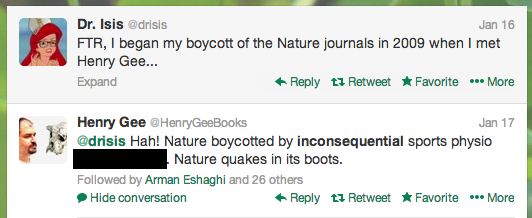
A couple of days ago on Twitter, Henry Gee, the senior editor of biological sciences at Nature, outed a widely-read, oft-shared, and sometimes controversial anonymous blogger, Dr. Isis. He took great glee in doing so because he didn't like some of her blog posts in which she called out some outrageous and sexist editorial decisions he had made (you may recall the awful "Womanspace" essay, described and eviscerated here by Dr. Isis), as well as her distaste for Nature’s bleak record regarding women in the sciences. The reaction in the scientific community online has been one of outrage that a senior, white, male took it upon himself to out a junior woman of color, and did so in such a publicly vindictive way, describing her as "inconsequential" and threatening on Twitter to "add (others) to the list" for daring to call him out for his boarish (at best) behavior (see Michael Eisen, co-founder of PLOS, condemn Gee here.).

Please do not dismiss this as "just happening online." Online (e.g. Twitter, blogs, Facebook, etc.) is *exactly* the place where important discussions about gender and color equity in the sciences occur on an hourly basis, it is *exactly* the place where junior and other marginalized scientists are finding a voice to share doubts and build power in a system that constantly knocks us down, and it is *exactly* the place where a Senior Editor at the science journal with the highest impact factor chose to publicly punish and damage an untenured woman of color who dared to challenge him.


As a biological anthropologist working toward tenure, a paper in Nature could “make” my career. I have as-yet-untenured colleagues at Ivies who get tsked-tsked for NOT submitting to Nature. The reverence for impact factors requires us to consider this the pinnacle of scientific publishing, at the same time that senior representatives of that very same journal with public platforms show absolutely no shame in trivializing our efforts as scientists or our very real struggles as outsiders in the Old White Boys Club. Struggles that make me feel like this a lot, and I actually have it pretty easy.

This continued outsider existence is what leads many to seek the clearly imperfect protection of an online pseudonym. Pseudonymity on the the internet has a long and defensible history, largely as protection of some kind, often against reprisals by employers. Sometimes as protection against cyber-stalking and sometimes real-life stalking and physical assault. But another reason is that it can offer protection against the clubbishness and bullying of privileged scholars with powers to hire, publish, grant funds. The power to deem one as a scientist of consequence. The power to refuse the pervasive poison that is their privilege and blindness. Henry Gee's outing of Dr. Isis clearly illustrates the continued vulnerability of women, people of color, and LGBTQ people speaking their truths and challenging Goliaths. Nature may well have a binder full of teh womenz (it’s so heavy, I hope they still have the strength to pat themselves on the back!), but they also got a million problems, most of which can be well visualized in a mirror, should they choose to look. 

Hahahahaha! I know, I know. That's not gonna happen. So, fine.  Nature, you are on my list. My list of overly inflated institutions that I've been taught to revere even when they've made it clear our kind isn't really welcome. I'm done. As long as you stand with Henry Gee and make no real efforts to change the climate for scientists like me, like Dr. Isis, like Danielle Lee, like millions of others, you won't be getting my papers (and trust me, I do some smoking hot, Nature-worthy science), you won't be getting my reverence. You don't get to push us around and have us thank you for it. 


Wednesday, November 30, 2011

Perishing from Publishing? Let this guide help!

We all know that publishing our best work is key to building a scholarly repuation and in turn, a compelling and successful tenure package. But as junior faculty/grad students/etc. it isn't always clear how to build a publishing strategy. Did you even know you needed a "strategy"? You do. Yikes, right?

Tom Boellstorff, current Editor-in-Chief of the American Anthropologist has recently published a really excellent essay on the subject of building your early career publishing strategy. He focuses on the choice of venue for your work and the peer-review process. His concept of the "Journal Triangle" is new to me but makes a lot of sense: publish in general journals (e.g. American Anthropologist, Current Anthropology), area journals (e.g. geographic area, species-centric journal such as Am J Primatology), and specialist journals (e.g. Placenta, Neuroscience, Bone Biology, etc.). Entirely without planning (alas, I did not have a strategy. Boellstorff, where were you??), I've done this and I'm pleased now to learn of the collateral benefits of doing so.

I have broken some rules here, mainly his edict to refrain from or strictly limit publishing in edited volumes as an untenured professor and I can attest to the wisdom of his advice. I have two chapters in print, one in press, and one in prep. I was blushingly gratified to have been invited to participate as a graduate student in one of the volumes and unwisely prepared some dissertation data for publication. The book took over 5 years  to come out and I couldn't publish those data as a journal article. That was dumb. (Note: the book itself is awesome and I'm very proud of my chapter!) That's why I now advise untenured folks looking to build up their pub list to reserve their original data for publication in journals. You can then later refer to it in a chapter, or even reprint the article in its entirety in a book. But if it's in the book first, it's done for.

The second chapter already in print wasn't too big a deal as I was third author in terms of effort. Sometimes you'll be invited to participate as an author because the other authors are leaning heavily on your work to build a section. If you're invited to do this, make it clear to the other authors what your availability to participate really will be. Be very protective of your effort on these kinds of co-authored projects. It's easy to say Yes! and Sure! I'll throw together a table! and No problem! I'll be happy to track down permission to use that figure! but it can be a real pain in the neck to follow through. Be sure you can really do it so as to protect not only your time but your reputation as a responsible collaborator.

Another tip: Don't underestimate the time a book chapter will take to write, even one that's based on previous work.  If you take even a modicum of pride in your work, it will take a lot longer than you expect and if the book is to be peer-reviewed, you might be surprised to find the review process even more exacting than that of a journal. And know going into it that the schedule will deviate from the best intentions. It just will. The slow turnaround is yet another excellent reason to publish your original data in a journal article.

Boellstorff's one easing of the no-edited-volume edict is being the editor yourself. Testify! I'm doing this now and I am lucky enough to have two smashing lady co-editors in Katie Hinde and Kate Clancy but it is a lot of work and has absorbed effort away from some other projects maybe I "should" be doing. That said, it's worth it because I deeply believe in the project, its potential impact on the field, and its timeliness (i.e. "This topic is so timely the book needs to happen NOW!"). AND I am concurrently working on journal articles and grant proposals. You can't just rest on the edited volume - whether it's just a chapter or the whole damn thing - for tenure (for most departments/schools that emphasize research over teaching, or articles over books. Your miles may vary so get smart about your local tenure culture.) So if you're going to do it, it needs to be for more than just vanity. You need to think about impact on the field, the timeliness of the topic, the quality of the contributors, and the potential pros/cons for your own scholarly reputation. Co-editing is a great idea IF YOU HAVE THE RIGHT EDITORIAL TEAM.

Good luck to you all as you craft your strategy! Please share your tips and questions in the comment section.

Friday, August 26, 2011

Confronting professional and cultural ethics: Gwen Robbins Schug

BANDIT is very pleased to host Dr. Gwen Robbins Schug as a guest blogger. In her compelling and beautifully written post, Gwen recounts a difficult ethical dilemma involving both scientific and cultural standards that stemmed from recent fieldwork in India.

(Re-)Wrapping a Sacred Bundle
Gwen Robbins Schug

"Anthropological researchers bear responsibility for the integrity and reputation of their discipline, of scholarship, and of science. Thus, anthropological researchers are subject to the general moral rules of scientific and scholarly conduct: they should not deceive or knowingly misrepresent (i.e., fabricate evidence, falsify, plagiarize), or attempt to prevent reporting of misconduct, or obstruct the scientific/scholarly research of others." AAPA Code of Ethics

"Ethics in Anthropology is like race in America: dialogue takes place during times of crisis." Carolyn Fluehr-Lobban (2003:pg. 1).


As an archaeologist, it is my belief that knowledge about the past is essential to our present understanding and should inform our future actions. Recently, I was involved in a situation where a colleague violated scientific ethics, plagiarized a paper, and attempted to obstruct future scholarly research. The situation soon became a public spectacle. I was challenged to devise a response that satisfied all of my various commitments to being a professional scientist, anthropologist, colleague and mentor. The liminal space I occupy as a biological anthropologist, with the ethical responsibilities of a scientist and the philosophical sensibilities of an anthropologist, led to an outcome that can only be called "the best of a bad situation". For this reason, I share my experience.

The Unravelling
Recently, I received a research fellowship and I took a sabbatical. I left my job, as an assistant professor at a small comprehensive University in the U.S. and I traveled to India, where I was to do research on two very important skeletal collections for 6 months. I had received permission to study paleopathology and trauma in this skeletal collection from the Government of India, Anthropological Survey of India, and the senior physical anthropologist in charge of the collection (Dr. Y). After about 10 days of waiting and meeting with the Head of Office at AnSI and Dr. Y, I began my work. A former student had traveled to India to work with me and was also granted permission by the head of office and the senior anthropologist to work on the skeletal material.

We examined a small collection first and then we turned our attention to the skeletal material from a very important archaeological site, a collection that has never been scientifically studied. The day we began work on that collection, Dr. Y was not in the office but he had left instructions for us to begin with the glass case in his office. This case was full of skulls from archaeological sites around India. They were all facing to the left because the case was not quite wide enough to accommodate them. There were only a couple from the site we were working on so we pulled those out and took them to the lab.

When we sat down to work, it was immediately apparent that one of the skulls was a specimen with a suspected trepanation, which had been a subject of speculation in the literature for decades. There was a depression fracture on the right side of the skull. Just below that, there was a small hole with a raised margin that suggested it could be a trepanation. This skull had been described a few times in 20th century writings about evidence for trepanation in prehistoric India, including a mention in a paper written about trepanation at a different site published by Dr. Y 10 years earlier. However, the skull had not been examined and the trepanation had not been confirmed. When Dr. Y returned to the office later that week, my student and I immediately informed him that we had found the specimen and we requested a CT scan (because the specimen is covered with a lot of preservative and confirmation required more work. He immediately exclaimed that our entire trip to India had just been validated by this discovery because he had been "looking" for the skull for many years and was happy we would finally be able to report on this evidence.

This trepaned skull turned out to be only the first in a long series of important results, which will lead to several publications and may very well revise our current ideas about life in the Indus Civilization. To me, the evidence for trepanation was interesting but primarily my interest was in the larger social issues of interpersonal violence, medical intervention, and hierarchy in the Indus Civilization. In fact, this evidence in combination with evidence for interpersonal violence in several skeletons that we examined early on led me to submit an abstract on that topic for an invited session at AAA later the same year.

After six months of working in India, seeing Dr. Y regularly when we were both in the labs and offices at AnSI, two things happened that challenged the relatively easy working relationship I thought I had developed there. The institution has generally remained aloof to foreign scholarship and I was proud of the apparent ease with which I had gotten access to their collections for the second time in my career.... until one afternoon when Dr. Y came into the lab where I was working. He started up a conversation about the results of my study and he asked me if I had seen a trepanation in another skeletal series I had studied in the repository. Knowing of his longstanding interest in trepanation, I shared with him that although it had been previously reported that there was a trepanation in a child's skull from Kalibangan, I had already confirmed that the skull was damaged postmortem and no such evidence existed.

During the course of this conversation, I asked Dr. Y if he wanted to write a paper reporting the confirmation of the case of trepanation I had discovered. When my field work began, we had discussed authorship and agreed that I would be first author on any and all publications resulting from my research and he would also be listed as an author. That day, I suggested that he could write a case study on the trepanation because I knew of his long-standing interest in the topic. We had not discussed it previously because we had both been traveling a lot and had usually not been present in the lab at the same time, except for a brief period early in my project.

Dr Y seemed very pleased that he would be able to report this case study and he mentioned that he had already started putting something together on the topic. Although I saw this comment as a potential red flag because we had not discussed it previously, I did not ask him for clarification and I dismissed the brief uneasy feeling and went on with my work. In fact I finished my work that very day, packed up all of my equipment and research supplies that afternoon, and headed home to write my final report and prepare to return home to the US.

That night, Mr. X, a reporter from a major newspaper wrote to ask a few routine questions for a story he was writing about trepanation in prehistoric India. I was not certain how he knew about the finding so I immediately wrote to Dr. Y. I told him that although we had discussed a potential paper that he would write on the trepanation, and although we discussed making him first author on that potential publication, I preferred to keep research results from the media until after a peer reviewed publication appeared.

I then wrote to the journalist and told him that I am the PI on a research project to study trauma and pathology in this skeletal collection housed at AnSI. I told him that I had not written a paper on the evidence for trepanation and was interested to know how he had learned of this aspect of my research. I also told Mr. X that I was not interested in commenting on his story and did not wish to be included in his article as the story was communicated without my knowledge or permission.

These two events marked the beginning of an unravelling, a spiralling chain of events which revealed scientific misconduct, a serious breach of scientific ethics by Dr. Y and a lack of diligence on the part of editors at a leading scientific journal in India. It is a long story and I will spare the reader most of the detail. Basically, the reporter informed me at that point that he was quite confused by my email. A manuscript was already published online in the current issue of a respected scientific journal. I was listed as second author on the paper and he was simply writing to me to get a comment about our conclusions. He noted that he found it odd that my affiliation was not listed on the paper. He had already spoken with Dr. Y (who was first author) and he never mentioned that I was the PI on the project. He had simply stated that I assisted with the analysis. At the end of this earthshaking email, he said simply that he would like to write an article on the serious breach of scientific ethics that had obviously occured in this case.

What followed was a series of phone calls and emails between myself, Dr. Y and Mr. X. All of this resulted in an article being published in the newspaper that accused Dr. Y of a serious breach of scientific ethics. Once the article came out, I contacted the director of Anthropological Survey of India and the journal editor. According to the AAPA code of ethics, I had a responsibility to inform the editor that a contribution in his journal was plagiarized and had been published without knowledge of one of the authors. As anyone can imagine, this was a delicate situation.

Culture Conflict- science and anthropology
I had been included as a second author on a paper that was submitted for publication, peer reviewed, and published without my knowledge. The contents of the paper were plagiarized from my research. It was unavoidable that an article was published in the newspaper because the reporter was the one who informed me of my own publication (which obviously made him suspicious that a bigger story existed). And I was under ethical obligation as a scientist to inform the journal editor (Dr. Z) and the director of AnSI of what had happened, uncomfortable as that was. So, I carefully wrote the necessary letters and then waited to see what the response would be (keeping in mind my position as a foreign scholar, and a young female one at that).

Shortly after the newspaper article came out, basically everyone I knew in India called me. All of my friends and colleagues expressed support for me. They gave me advice on whom to speak with, how to handle myself, and when to sit quietly and wait for a response. Many of my American colleagues also called me to express support as well. One thing that all of these calls had in common was an almost immediate outpouring of similar stories, in India and in the United States. Most of these stories were from young, female scholars. Most of them were not cathartic moments.

The director of AnSI wrote to Dr. Y and demanded an explanation. In an email he wrote to me that Dr. Y's conduct was unethical and unacademic. Dr. Y's formal letter of response was inadequate and contained obvious fabrications. For example, Dr. Y claimed that he did not show me the paper before its publication because it was submitted from the field. On the published version of the paper, there was a date of submission that did not corroborate this story. As emails and phone calls flew back and forth and all over India (all the way up to the Ministry of Culture), the scientific ethical issues were clear. AnSI handled the entire issue with respect for scientific enquiry, investigating the matter and disciplining the scientist involved.

Dr. Z, the journal editor, had a different response. In scientific publishing, a charge of plagiarism is enough to retract a paper. Dr. Z did not wish to retract the paper, even though I initially requested him to do so. Although he had been given evidence to demonstrate that clearly Dr. Y had committed an ethical violation by publishing without my knowledge and although there was evidence for the plagiarism, Dr. Z wanted to publish an erratum and correct the authorship and affiliation details while leaving the paper intact. Now it was my turn to wrestle with the ethical issues, not the ethics of being a scientist but the ethics of being an anthropologist.

The "appropriate" response to a breach of ethics of this magnitude is clear. Within the scientific community in the United States, ethical violations are ideally handled immediately and thoroughly because every aspect of the scientific process is based on trust. Science is not the "Truth" but it is a set of claims about the world and the scientific literature is a permanent historical record of experiments, observations, and interpretations. As a society, we rely heavily on this record and most scientists and concerned people would agree that integrity is crucial to the process of science.

For this reason, there are reasonably clear ethical standards of practice in the United States. Not everyone lives up to those standards all of the time and thus our professional associations and institutions have written policies for dealing with misconduct. Gray areas can emerge about details of particular cases but ultimately errors in authorship should result in an erratum, plagiarism should result in retraction.

But what about anthropological ethics?
The editor of the journal expressed a preference for leaving the paper in the journal. I tossed and turned, night after night about the anthropological ethical issues of imposing my own standards for ethical conduct on someone from a different culture. Although there are guidelines for how to proceed when scientific misconduct is clear, there are no clear rules for knowing how to proceed when it becomes apparent that scientists from two different cultures have conflicting goals, interests, norms, and standards of scientific practice.

Dr. Z had a solution, his way of solving the problem fit within his own tradition and he did not wish to retract the paper. In a sense, I had simultaneously respected and violated a trust by calling attention to the situation. I felt scientific ethics demanded that much from me. As a consquence, Dr. Y had threatened at one point to restrict access for foreign scholars again and the situation obviously had the potential to negatively impact future anthropological and scientific research. Dr. Z clearly expressed his solution and although it was not what I wanted, I eventually decided that I had to respect his authority as journal editor and his reading of the correct response to an ethical dilemma. Basically, anthropological ethics suggested it was wrong to enforce my own view of ethical practice in scientific journal publishing over views expressed by a highly qualified scientific journal editor. In the end, I consented to the erratum and the paper was left in the journal.

Wrapping up
I would sum up the dilemma by evoking the interdisciplinarity of biological anthropology, which does not always easily straddle science and anthropology. As a PI, I am responsible for ensuring that the research is conducted ethically and this includes an ethical dissemination of the results. I found Dr. Y's article to be unprofessional and misleading in its claims to have 'discovered' the 'first evidence' of 'brain surgery' in India. More importantly, if I am aware of unethical conduct, I have a responsibility as a scientist to report that to the authorities in place. I have a responsiblity for the factual content of publications on which my name appears and I have a responsiblity to tell the truth when a concern is brought to my attention. When scientific literature is published, it is important for practical reasons that all authors have an opportunity to write, review, edit and respond to reviewer comments. If I said nothing about my name being placed on a paper without my knowledge or consent, I am tacitly condoning an unethical practice.

However, I also have a responsibility as an anthropologist to respect the solutions of people in the communities where I engage in research. I must carefully consider the social and political implications of my research and my behavior. I have a responsibility to be reflexive about my actions and to do no harm, including to future colleagues. I have a responsibility to "preserve opportunities for future fieldworkers to follow [me] to the field" (AAPA code of ethics). I have a responsibility to behave as a guest and to respect the views and opinions of my hosts, their concept of ethical behavior, and the consequences for violating those norms.

I think that the AAPA guidelines summed well the position of the biological anthropologist in a case like this one: "Active contribution and leadership in seeking to shape public or private sector actions and policies may be as ethically justifiable as inaction, detachment, or noncooperation, depending on circumstances" (pg. 2). In this case, I chose to do both. I was not silent about the ethical violations but I did not demand a particular resolution either. I tried to satisfy ethical obligations as a scientist while respectfully negotiating my position as an anthropologist. By speaking up, I took a stand that is impossible for many junior scientists (particularly women) who are vulnerable to abuses of power like plagiarism, discrimination, and sexual harassment. Through the anthropological perspective, I found a path that honored those vested with authority over scientific enquiry and publishing in India. I don't know if scientists and anthropologists would agree with the way that I handled the situation. I do know that I now sleep very well at night.

Saturday, August 6, 2011

Gwen Robbins Schug - awesome scholar, awesome book

As has been hinted previously on the BANDIT blog, Dr. Gwen Robbins Schug's new book has just been released! It is entitled, "Bioarchaeology and Climate Change: a view from South Asian prehistory". A short synopsis of the book is available on her website.

The book is published by University Press of Florida as part of Clark Larsen's book series "Bioarchaeological Interpretations of the Human Past: Local, Regional, and Global Perspectives". It will also be available through Oxford University Press Online later this year. If one's academic institution subscribes, OUPO carries fully searchable academic books, which can be downloaded by chapter or in their entirety without cost to the patron.

Congratulations to Gwen on the publication of her book!

Wednesday, March 2, 2011

New features at American Journal of Physical Anthropology

Wiley-Blackwell announces two cool new features at AJPA. Now you can track the most accessed articles of 2010, as well as the articles most cited in 2010 (not necessarily papers written in 2010).

Wednesday, October 6, 2010

A vanity press by any other name is still a vanity press

Have you heard of VDM Verlag? If you're like me, you've received an email "inviting" you to publish your dissertation with them. It sounds pretty gratifying, because hey, isn't Verlag a subsidiary Springer, the really well-respected publisher of lots and lots anthropology and primatology titles? Um, no. This is a different Verlag altogether, and one that carries with it real risks to your scholarly reputation. Thanks to Stacey Tecot for sharing with me the warning the University of Arizona is circulating to its faculty:

Beware "Vanity" Publishing Houses
We have recently become aware of a situation where some of our junior academics are publishing "books" with VDM Verlag, a German publishing house known for publishing the theses of PhD students in that country where it is sometimes necessary to complete the degree.

VDM solicits theses from academics and publishes them in a very poor quality format to keep costs low, and returns minor royalties if at all to the author.

Interestingly, VDM encourages the academic to purchase copies of their own text, much like the three Belbo, Diotallevi and Casaubon in Umberto Eco's Foucault's Pendulum encouraging authors to buy their own books of occult nonsense their vanity publishing house have printed. Just as with that story, VDM appears to cover its costs from the author's purchases.

The problem?

Other than simply ripping off the author (the royalties are abysmal and the terms are worse), the near scam is becoming very well known amongst researchers, reducing the perceived quality of VDM Verlag:

Writer Beware Blogs
Chronicle Forums
PhD Comics

Further, the books published by VDM Verlag are NOT independently peer reviewed or even proofread or copy-edited!! ...

and should not therefore appear as such in the ERAMIS system.

Unfortunately, we have several researchers who have fallen into the trap, written VDM-published books, and are now citing these books in promotion applications, apparently with the genuine belief VDM Verlag is a respected publisher, not the vanity press it appears to be. This jeopardises the quality of our institution through association with such a press; our academics risk looking like fools in citing these books as significant publications.

Wednesday, September 29, 2010

Whodunit? Navigating authorship

I'm in the midst of prepping and mapping out several publications that arise from various collaborative projects and I'm trying to figure out authorship order. Ugh. In several cases, I'm doing the bulk (and in some cases, all) of the study design, data analysis, stats, and writing so I'm obviously the first author, right? Weeelll....not so fast. While I'm still building a record of first-authored papers, my mentors are alerting me to the need for some last-authored papers prior to tenure, to demonstrate my position as an independent researcher. Then what do I do with all the various collaborators, students, former mentors, current benefactors, etc. in the middle? Yikes. And it's difficult to see the distinction when the "person who did the bulk of the work" (traditionally first author slot) and "senior person" (traditionally last author slot) are one and the same.

I'm learning that a lot of this is discipline specific and what is conventional in anthropology may be quite a bit different from the norm in the biomedical or health sciences, where several of us publish (and where I make my current institutional home). Adding to the confusion, your local promotion and tenure committee may have an idea about what authorship order signifies that differs from what you and your discipline think. What I'm hearing from my mentors is that disciplinary conventions are fine to follow, but that I should be prepared to defend those decisions, both in my own voice and also in the letters from outside tenure referrees. I think a good start is to write up a "who did what" document for each publication - some journals *require* such a statement - and tuck it away in your tenure file, so you can easily refer to this when the time comes. Best practice is to have a conversation with collaborators at the project's inception regarding authorship rather than wait until you're about to submit and find out there's a dispute.

Maybe this link will help us figure it out. While it is specifically geared toward Nature journals, the advice and the associated links are generic enough to be broadly applicable. See also this, this, and this for additional guidelines.

Thursday, July 1, 2010

Guide to reviewing manuscripts

Crazy-thanks to Dr. Colleen Nyberg for passing along this very helpful guide to reviewing manuscripts. Although the authors of the article are radiologists, their guidelines are fairly universal. Especially helpful is their comparison of informative and non-informative reviews. Both authors and reviewers should learn something new from this piece.

Wednesday, May 19, 2010

It's the time for the season of writing...

For most of us, the official school year is over giving way to that holy grail of the academic life, SUMMERS OFF!!(HAHAHAhahahahahahaha...hahahahaha...*gasp*....hahahahahaha..), perhaps better known as "damn, I better write about 50 pages a day or I am screwed." The writing could be finishing up those manuscripts that have been languishing under a pile of exams, grant proposals for summer deadlines, book prospectuses, or even dissertations. For those ABD's starting new positions this fall, the summer can be the final brutal stretch of non-stop writing before having to load up a moving truck. If all of this is overwhelming (and dammit, if it's not, then you are so much of a rock star that I don't think I can be friends with you) please check out Writing Your Dissertation in Fifteen Minutes a Day: A Guide to Starting, Revising, and Finishing Your Doctoral Thesis, the classic tome by Joan Bolker. There are of course many other excellent guides on this topic as well as productivity more generally, but this is the one I find most helpful, and it extends to writing projects other than dissertations. While geared a little more toward the humanities and the more social of the social sciences (e.g. we really need to incorporate time for labwork and data analysis into our writing process - they go hand in hand), the overall tone is approachable and reasonable.

An important tip for creating time to write that Bolker ignores but that worked wonders for me while writing my dissertation: don't shower, change your clothes, or leave the house for days at a time. Also, Doritos and Diet Coke help. (You're welcome!)

Friday, May 14, 2010

Slicing, dicing, reviewing?

I like to peruse the Chronicle of Higher Education fora. You'll find a vibrant, clever, helpful, and often volatile community there, comprising academics at all stages and venues. Today I thought I'd post a topic of interest to new investigators - what's your duty as a manuscript reviewer? The particular issue at hand is how to handle what you suspect to be an LPU, or "Least Publishable Unit", the smallest portion of a study that could conceivably stand alone as a publication, but the discussion that follows is more generally applicable. As both a reviewer and a reviewee, it's good to know the different ways people judge the work of others.

Wednesday, May 5, 2010

How to Get an Article Accepted at American Anthropologist (or Anywhere)

In 2008, Tom Boellstorff (editor-in-chief of American Anthropologist) offered some guidelines to keep in mind when crafting a manuscript for publication. Many of these seem crazy obvious (be sure to accept all changes and check for typos!) but as an editor he's seen all kinds of stupid. Don't let your paper be stupid.

How to Get an Article Accepted at American Anthropologist (or Anywhere)

Monday, May 3, 2010

Journals for biological anthropology papers?

One of the challenges of publishing is deciding where to submit. At lunch today with several other biologically- and medically-minded anthropologists from a range of different departments in the Midwest, we discussed where to send our papers for publication. What audience do we hope to target with which piece of research or theoretical exploration? How will the particular venue in which we seek to publish affect our department's and college's assessment of our scholarly activity (i.e. renewal/promotion/tenureability)? Some colleagues shared that their departments seemed to value publications in the broader anthropology journals more than those in "specialist" journals like AJPA, AJHB, etc. even though the impact factors for some of the bioanthro journals are higher than those for Current Anthropology, for example. These are things that are important for junior faculty to find out, and it will likely vary according to your local climate.

Thought I'd share the list we came up with and add some suggestions of my own, and solicit other suggestions from fellow BANDITs. The list I present is biased toward my interests and those of my lunch dates (primatology, anatomy, developmental biology, reproduction, nutrition) so please help add to it!

Broader (4-fields?) anthropological journals:
American Anthropologist
Current Anthropology
Annual Reviews of Anthropology

"Specialist" journals:
American Journal of Physical Anthropology
Yearbook of Physical Anthropology
American Journal of Human Biology
American Journal of Primatology
International Journal of Primatology
Journal of Medical Primatology
Journal of Human Evolution
Evolutionary Anthropology
Journal of Bone and Mineral Research
Bone
Journal of Osteoarchaeology
Annals of Human Biology
Human Biology
Anatomical Record
Journal of Morphology
Developmental Dynamics
Developmental Biology
Journal of Evolutionary Biology
Current Biology
Reproduction
Human Reproduction
Fertility and Sterility
Biology of Reproduction
Journal of Reproductive Immunology
American Journal of Clinical Nutrition
Journal of Nutrition
American Journal of Epidemiology
International Journal of Epidemiology
Journal of Epidemiology and Community Health
Obesity
Hormones and Behavior