Showing posts with label tenure. Show all posts

Tuesday, January 21, 2014

Outing Dr. Isis: A retaliation of consequence by a Nature editor

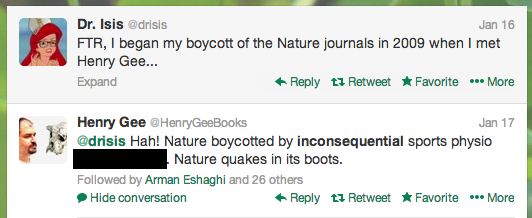
A couple of days ago on Twitter, Henry Gee, the senior editor of biological sciences at Nature, outed a widely-read, oft-shared, and sometimes controversial anonymous blogger, Dr. Isis. He took great glee in doing so because he didn't like some of her blog posts in which she called out some outrageous and sexist editorial decisions he had made (you may recall the awful "Womanspace" essay, described and eviscerated here by Dr. Isis), as well as her distaste for Nature’s bleak record regarding women in the sciences. The reaction in the scientific community online has been one of outrage that a senior, white, male took it upon himself to out a junior woman of color, and did so in such a publicly vindictive way, describing her as "inconsequential" and threatening on Twitter to "add (others) to the list" for daring to call him out for his boarish (at best) behavior (see Michael Eisen, co-founder of PLOS, condemn Gee here.).

Please do not dismiss this as "just happening online." Online (e.g. Twitter, blogs, Facebook, etc.) is *exactly* the place where important discussions about gender and color equity in the sciences occur on an hourly basis, it is *exactly* the place where junior and other marginalized scientists are finding a voice to share doubts and build power in a system that constantly knocks us down, and it is *exactly* the place where a Senior Editor at the science journal with the highest impact factor chose to publicly punish and damage an untenured woman of color who dared to challenge him.


As a biological anthropologist working toward tenure, a paper in Nature could “make” my career. I have as-yet-untenured colleagues at Ivies who get tsked-tsked for NOT submitting to Nature. The reverence for impact factors requires us to consider this the pinnacle of scientific publishing, at the same time that senior representatives of that very same journal with public platforms show absolutely no shame in trivializing our efforts as scientists or our very real struggles as outsiders in the Old White Boys Club. Struggles that make me feel like this a lot, and I actually have it pretty easy.

This continued outsider existence is what leads many to seek the clearly imperfect protection of an online pseudonym. Pseudonymity on the the internet has a long and defensible history, largely as protection of some kind, often against reprisals by employers. Sometimes as protection against cyber-stalking and sometimes real-life stalking and physical assault. But another reason is that it can offer protection against the clubbishness and bullying of privileged scholars with powers to hire, publish, grant funds. The power to deem one as a scientist of consequence. The power to refuse the pervasive poison that is their privilege and blindness. Henry Gee's outing of Dr. Isis clearly illustrates the continued vulnerability of women, people of color, and LGBTQ people speaking their truths and challenging Goliaths. Nature may well have a binder full of teh womenz (it’s so heavy, I hope they still have the strength to pat themselves on the back!), but they also got a million problems, most of which can be well visualized in a mirror, should they choose to look. 

Hahahahaha! I know, I know. That's not gonna happen. So, fine.  Nature, you are on my list. My list of overly inflated institutions that I've been taught to revere even when they've made it clear our kind isn't really welcome. I'm done. As long as you stand with Henry Gee and make no real efforts to change the climate for scientists like me, like Dr. Isis, like Danielle Lee, like millions of others, you won't be getting my papers (and trust me, I do some smoking hot, Nature-worthy science), you won't be getting my reverence. You don't get to push us around and have us thank you for it. 


Wednesday, November 30, 2011

Perishing from Publishing? Let this guide help!

We all know that publishing our best work is key to building a scholarly repuation and in turn, a compelling and successful tenure package. But as junior faculty/grad students/etc. it isn't always clear how to build a publishing strategy. Did you even know you needed a "strategy"? You do. Yikes, right?

Tom Boellstorff, current Editor-in-Chief of the American Anthropologist has recently published a really excellent essay on the subject of building your early career publishing strategy. He focuses on the choice of venue for your work and the peer-review process. His concept of the "Journal Triangle" is new to me but makes a lot of sense: publish in general journals (e.g. American Anthropologist, Current Anthropology), area journals (e.g. geographic area, species-centric journal such as Am J Primatology), and specialist journals (e.g. Placenta, Neuroscience, Bone Biology, etc.). Entirely without planning (alas, I did not have a strategy. Boellstorff, where were you??), I've done this and I'm pleased now to learn of the collateral benefits of doing so.

I have broken some rules here, mainly his edict to refrain from or strictly limit publishing in edited volumes as an untenured professor and I can attest to the wisdom of his advice. I have two chapters in print, one in press, and one in prep. I was blushingly gratified to have been invited to participate as a graduate student in one of the volumes and unwisely prepared some dissertation data for publication. The book took over 5 years  to come out and I couldn't publish those data as a journal article. That was dumb. (Note: the book itself is awesome and I'm very proud of my chapter!) That's why I now advise untenured folks looking to build up their pub list to reserve their original data for publication in journals. You can then later refer to it in a chapter, or even reprint the article in its entirety in a book. But if it's in the book first, it's done for.

The second chapter already in print wasn't too big a deal as I was third author in terms of effort. Sometimes you'll be invited to participate as an author because the other authors are leaning heavily on your work to build a section. If you're invited to do this, make it clear to the other authors what your availability to participate really will be. Be very protective of your effort on these kinds of co-authored projects. It's easy to say Yes! and Sure! I'll throw together a table! and No problem! I'll be happy to track down permission to use that figure! but it can be a real pain in the neck to follow through. Be sure you can really do it so as to protect not only your time but your reputation as a responsible collaborator.

Another tip: Don't underestimate the time a book chapter will take to write, even one that's based on previous work.  If you take even a modicum of pride in your work, it will take a lot longer than you expect and if the book is to be peer-reviewed, you might be surprised to find the review process even more exacting than that of a journal. And know going into it that the schedule will deviate from the best intentions. It just will. The slow turnaround is yet another excellent reason to publish your original data in a journal article.

Boellstorff's one easing of the no-edited-volume edict is being the editor yourself. Testify! I'm doing this now and I am lucky enough to have two smashing lady co-editors in Katie Hinde and Kate Clancy but it is a lot of work and has absorbed effort away from some other projects maybe I "should" be doing. That said, it's worth it because I deeply believe in the project, its potential impact on the field, and its timeliness (i.e. "This topic is so timely the book needs to happen NOW!"). AND I am concurrently working on journal articles and grant proposals. You can't just rest on the edited volume - whether it's just a chapter or the whole damn thing - for tenure (for most departments/schools that emphasize research over teaching, or articles over books. Your miles may vary so get smart about your local tenure culture.) So if you're going to do it, it needs to be for more than just vanity. You need to think about impact on the field, the timeliness of the topic, the quality of the contributors, and the potential pros/cons for your own scholarly reputation. Co-editing is a great idea IF YOU HAVE THE RIGHT EDITORIAL TEAM.

Good luck to you all as you craft your strategy! Please share your tips and questions in the comment section.

Monday, October 4, 2010

Jumping from the Adjunct Track to Tenure Track - can it be done?

Given that many anthropology ABD's and newly-minted PhD's will be hired as adjuncts and visiting assistant professors (some even at their PhD institution) but have a tenure track position set as their primary goal, it seems worth exploring whether/how this transition occurs. This recent thread in the Chronicle of Higher Ed forum is a good place to start since it is largely first-person. A great variety of experiences and opinions abound, but there seems to be general agreement that those adjuncts hoping or assuming that at some point they will be offered a tenure-track position in their current department (or hell, even just an interview!) may be hoping in vain:

"I fear that a lot of adjuncts think that there is some sort of implicit understanding that they are on the track to get on the tenure track at the institution where they are teaching. Fairly or not, the opposite is more often the case."

"Community colleges, I understand, are more flexible. We're simply not. At our R-1, there is a handbook clause forbidding "inbreeding," i. e., hiring (tenure track) our own graduates. We can't do it. Further, since we're a research uni, we can't hire on the tenure track anyone who won't get tenure--i. e., anyone who hasn't published. We hire with nationwide ads, and we sometimes hire on the TT people who already have published books (yes, the humanities job market is horrendous)."

"By the way, we shouldn't just blame adjuncts about this. All too often, they get vague suggestions and hints that there is the possibility they'd get hired to TT jobs. Sometimes "promises," which are subsequently broken. So deans, chairs, and TT faculty share some of the blame. I actually had a higher level admin say something like, "Wouldn't it be nice to hire some of our own doctoral grads?" I disappointed that admin when I suggested it would be scandalous. And I wouldn't be at all surprised if said admin had dropped a few vague hints to a past grad or two."

What is considered one of the biggest obstacles (barring not yet finishing the PhD) is that the job requirements for adjuncting are quite different from those for TT faculty. The service and research requirements, even at teaching-focused colleges, are significantly greater for TT faculty than for adjuncts. And departments hire folks for TT jobs because they've decided the odds for tenure are high enough to take the risk. They make that determination on the basis of a number of things, including research productivity, grants, and publications, areas that are tough - though absolutely not impossible - to beef up as an adjunct. And even if you are able to do this as an adjunct, it may not make it easier for you to lobby for a pay increase as long as you remain an adjunct. I think this sums that calculus up well:

"While it makes sense for adjuncts to continue research and publishing in order to remain competitive for tenure-track positions, it is important to remember that research is not part of the expectations or responsibilities of an adjunct, and as such they will not be paid for such activities while they remain adjuncts...
In the same way, simply being overqualified for your current job is not an adequate reason to advocate for more pay, it simply provides you with the opportunity to move into a job with a higher rate of pay for which you are qualified.
In other words, it doesn't matter one bit to your university if you do research and are capable of performing service while an adjunct if that is not part of the job description, since the university is not asking you to do this as a condition for your continued employment."

Several posters on the thread have made that transition from adjunct to TT in their current department, so it's not something that NEVER happens, but it seems reasonable to temper expectations by focusing on productivity outside the classroom as much as is humanly possible to beef up the CV as though you were only applying to external positions. Perhaps if you can demonstrate to your current institution that in addition to being the stellar instructor you've been as an adjunct, you have published, organized symposia, published, achieved external funding, acted as mentor for a PhD candidate elsewhere, um, published - all the things they look for as hallmarks of tenureability - you can be that person who makes the transition. The reality is that for most R1 and liberal arts programs (even the ones who seem happy with your adjuncting self), those criteria will matter more than simply having great teaching evaluations and an impressive roster of classes you can teach.*


*I do not intend to trivialize excellence in teaching - we all know how much work and passion and time go into that. This is about what is valued by the programs looking to add to their tenure track rosters.

Wednesday, September 29, 2010

Whodunit? Navigating authorship

I'm in the midst of prepping and mapping out several publications that arise from various collaborative projects and I'm trying to figure out authorship order. Ugh. In several cases, I'm doing the bulk (and in some cases, all) of the study design, data analysis, stats, and writing so I'm obviously the first author, right? Weeelll....not so fast. While I'm still building a record of first-authored papers, my mentors are alerting me to the need for some last-authored papers prior to tenure, to demonstrate my position as an independent researcher. Then what do I do with all the various collaborators, students, former mentors, current benefactors, etc. in the middle? Yikes. And it's difficult to see the distinction when the "person who did the bulk of the work" (traditionally first author slot) and "senior person" (traditionally last author slot) are one and the same.

I'm learning that a lot of this is discipline specific and what is conventional in anthropology may be quite a bit different from the norm in the biomedical or health sciences, where several of us publish (and where I make my current institutional home). Adding to the confusion, your local promotion and tenure committee may have an idea about what authorship order signifies that differs from what you and your discipline think. What I'm hearing from my mentors is that disciplinary conventions are fine to follow, but that I should be prepared to defend those decisions, both in my own voice and also in the letters from outside tenure referrees. I think a good start is to write up a "who did what" document for each publication - some journals *require* such a statement - and tuck it away in your tenure file, so you can easily refer to this when the time comes. Best practice is to have a conversation with collaborators at the project's inception regarding authorship rather than wait until you're about to submit and find out there's a dispute.

Maybe this link will help us figure it out. While it is specifically geared toward Nature journals, the advice and the associated links are generic enough to be broadly applicable. See also this, this, and this for additional guidelines.

Tuesday, September 28, 2010

Picking your battles on the tenure track

Great essay in the Chronicle of Higher Ed on what probationary (i.e. pre-tenure) faculty should know about stepping into the political fray within their departments. Always be aware that no matter how "justified" you view your instances of speaking up for just causes, if you speak up too often and too forcefully early in your career, you could be labeled a troublemaker and this could spell trouble come tenure time.

This same topic is discussed at great length throughout the CHE forums under the more colorful and descriptive umbrella of STFU: Shut the F&*% Up. See here, here, and here for examples of this principle in action.

Monday, August 23, 2010

An open letter to the 2010-11 tenure track cohort

A pithy CHE post from back in May designed for folks getting ready for their first year on the tenure track. Heading into year two, I still found much of this advice incredibly useful.

Check in at the 2010-11 cohort forum at CHE to make friends.

Wednesday, July 28, 2010

Goodbye to Those Overpaid Professors in Their Cushy Jobs

Look, I don't post these kinds of articles to depress you. I think the issue of tensions among members of the academy regarding teaching loads and the public perception of the tenured life is fascinating, and will only grow more fraught as the economic downturn continues and as the business model of higher education becomes more focused on the bottom line. The article reports that some academics are growing more vocal in their disdain for colleagues who eschew taking on additional courses or administrative duties when the overall economic picture on most campuses is bleaker by the semester:

"Last September some professors at the University of California decided that not working on days they were supposed to teach might actually help the university win more support from the Legislature. The professors called for a walkout of classes—to demonstrate how budget decisions were affecting students—even though the president's office had prohibited them from taking furloughs on teaching days.
James Hamilton, a tenured professor of economics on the San Diego campus, called out his fellow professors on his blog. "If some of my colleagues perceive that they now have better opportunities than teaching at the University of California, I'd encourage them to resign so that they can take advantage of those opportunities," he wrote. "If not, they need to stop whining and do their jobs. And perhaps even be thankful that, unlike many other Americans, they still have one.""


Public perception is the another target of the article:
"The professoriate may be policing its own perceived slackers, and there may not be as much grumbling from legislators as there once was about professors out mowing their lawns on Friday mornings. But what about professors' pay—does it qualify as cushy?
For those people lucky enough to land full-time jobs at universities, the pay can be good, although, of course, it's all relative. For example, a mathematician at a college or university makes an average salary of $72,320 per year, according to the Bureau of Labor Statistics. (An annual survey by the College and University Professional Association for Human Resources provides a more detailed breakdown: A full professor in mathematics and statistics at a four-year institution makes $84,32; an associate professor, $66,012; an assistant professor, $55,765; a new assistant professor, $55,186; and an instructor, $42,782.) That compares with an average salary of $67,430 for an accountant or auditor, according to BLS figures, and $75,22 for a statistician.
The average annual salary for English instructors at a college or university, meanwhile, is $65,570, according to the bureau. That's about $10,000 per year more than high-school teachers make ($55,150), but high-school teachers probably started earning real wages at least six years earlier, and have a better shot at tenure."


I think the article obscures some issues, particularly those regarding faculty unionization and work-life balance, but I find this to be a really compelling piece. What's your take?

Monday, July 12, 2010

Working moms on the tenure track - yeah, it's hard

Study from the AAUP corroborates what many women already know: trying to attain tenure and be a mother is really difficult, largely because institutional support is insufficient, but also because of internal pressure and guilt and interpersonal gender dynamics. The study reports that becoming a father does not have the same deleterious effect on male faculty.

Read the original study here.

Tuesday, June 22, 2010

It's better to burn out than it is to rust...

A new AAUP survey on the burnout phenomenon among academics is familiarly sobering.

The study was conducted using the Maslach Burnout Inventory Educators Survey, which "assesses three aspects of burnout on a multi-point scale. The categories include:
• Emotional Exhaustion: Feelings of being emotionally overextended or just worn out with work. (Average Scores: 14-23).
• Depersonalization: An unfeeling and impersonal response toward recipients of one’s service, care, treatment or instruction. (Average Scores 3-8).
• Personal Accomplishment : Feelings of competence and successful achievement in one’s work. (Average Scores 36-42)."

The higher the score, the greater the burnout. Interestingly, the academics reporting the highest composite "burnout" scores were untenured faculty, compared to non-tenure track faculty and tenured faculty. Also, women had higher scores in Emotional Exaustion. Although these findings might not seem so surprising anymore, it is important that we keep some sense of perspective, and I want to share some comments from a BANDIT member who provides that perspective eloquently:

"I realize all jobs cause some level of stress and that the tenure process is pretty stressful due to it's ambiguity. I have recently taken part in several studies on work/life balance and it is becoming more and more apparent that there is no formula for achieving tenure and/or appropriate work/life balance. Here, the three categories of our commitment to the university are reported to be measured as service (20%), scholarship (40%), and teaching (40%). Yet, it is evident that if you really pursue only 20% service, it will not work so well. So, it's more 40%, 40%,40%, thereby making little sense.... On the other hand, I feel strongly that we are in a pretty amazing position in that we are lucky enough to get a job that allows us to run around after monkeys in beautiful places (or basically in a dream job), have unstructured time during many portions of the year, and get to teach eager wide-eyed (usually) students in the things where we are passionate. So, I tire quickly of campus negative burned out attitudes. I think it is important that as new faculty, we work to avoid stress and attempt to appreciate that we have these amazing opportunities. My observations suggest that the burned out and stressed teach pretty poorly and are bitter about their accomplishments. That is just silly."

Thursday, May 20, 2010

Preparing for tenure reviews

With the school year wrapping up, folks on the tenure track are getting their reviews - 1st year, 2nd year, mid-tenure. I haven't been through it yet (it's set for June or July) but I have been keeping a "tenure journal" wherein I document everything I've done since I started at my school. Pubs, abstracts submitted for conferences, grants and $ amounts applied for (even if I don't get them it shows I tried and if I write down all the details now I won't have to scramble later), nice emails from students, etc. From that I've abstracted a year-in-review document that I can give my chair once he starts the process. It all helps me feel like I have a little bit of control over a process that is largely external.

Another thing that I've found to be helpful is to check the Chronicle of Higher Ed fora for firsthand experiences and advice:

Advice/reassurance needed for tt prof after second year review

Things not to do pre-tenure

Criticism of teaching in annual review

3rd yr review