Tuesday, February 25, 2014

What if 40/40/20 is really 40/40/40? (Or, why do more service than you’re asked to, even if it gets you in trouble?)

Guest Bandit Blogger Dr. Christopher Dana Lynn shares his experiences with the slipperiest part of your professional portfolio, service:

I first experienced this one summer during grad school when my department paid me a modest sum to overhaul their website. In doing so, I had to introduce myself to every member of the faculty to update their bios & get new photos. This interaction was integral to my success in the department, as everyone came to know me & support me. I learned about shared research interests I had with faculty doing widely disparate things that weren’t otherwise apparent. This taught me firsthand the value of networking thru service.

Me & my clan circa grad school 
(yes, I'm including this for the gratuitous "cute" factor).
The first significant service outside my department for which I wasn’t also being paid was as a program officer for the first NorthEastern Evolution Psychology Society (NEEPS) conference. This offshoot of the Human Behavior & Evolution Society had started up at SUNY New Paltz, 15 minutes from my house. How could I not get involved? That led, in part, to meeting other faculty at New Paltz, though I was a grad student at the University at Albany, & offers of lecturer positions at two institutions & a position on the executive committee of the newly formed Evolutionary Studies (EvoS) program at New Paltz. These gigs helped me make $, refine my abilities, & learn admin skills.

However, one of the reasons I got hired at the University of Alabama in 2009 was because I had developed breadth into evolutionary psychology thru the NEEPS & EvoS service. When I arrived at UA, I jumped into involvement with a group of like-minded faculty called the Evolution Working Group, which hosts an evolution-oriented lecture series. In conjunction with this group, we started our own EvoS program at the University of Alabama.  The program involves a minor, which I co-direct, & a student-run club, for which I am faculty mentor.  For the minor to work, I developed & teach several classes over my expected teaching load of 2/2 (two courses per semester) & help the students organize & host an annual Darwin Day event.


TMSE kids doing a forensics activity as 
part of our anthro outreach course
In addition to the EvoS program, I run a research group every week that I modeled on the evolutionary psychology lab I was part of as a grad student.  At this point, it is mostly undergrads & my few grad students, but we meet for 3 hours every week to collaborate on research, which amounts essentially to teaching another course. Finally, when my kids were in 3rd grade, their PTA asked me to teach a semester-long anthropology course as part of the partnership their school has with the University of Alabama. By this point, my dean had echoed my grad school adviser several times, stating in my annual recommendation for retention that my service load is too extensive & varied for someone at my career stage & that I should scale back. However, as a chairperson of another department & parent of one of my children’s classmates pointed out, our children grow up fast & won’t give us this opportunity with them again. Although I swore I would only teach the class the first year, it was very successful—who learns anthropology in elementary school?! How could I not continue to teach that?

Last year, I figured out how truly important all this extra work has been for me. I began the process of applying for a National Science Foundation CAREER grant, which requires integration of teaching innovation. I realized that all the service I have been doing was exactly what I needed for developing a “career trajectory.” Thru it, I had developed substantial collaborations throughout my university, indicating my willingness & ability to work across disciplines & with teams. I have met scholars throughout the world by organizing their lectures here who have expressed willingness to vouch for me at tenure time. When I go to conferences, I know far more people than I otherwise would & feel a sense of mission in promoting these programs we’ve developed.

So, what’s the take-home message? Do service willy nilly? Not hardly. But don’t shy away from it either. Everyone is busy, but your willingness to take on just a little more will be greatly appreciated &, to invoke some of my favorite evo theory, it is a costly honest signal of your willingness to cooperate that will reward you with unforeseen dividends!

Christopher D. Lynn, Ph.D.
Assistant Professor of Anthropology
Co-director of Evolutionary Studies program
University of Alabama
Tuscaloosa, AL 35487

Follow me on Twitter: @Chris_Ly


Tuesday, January 21, 2014

Outing Dr. Isis: A retaliation of consequence by a Nature editor

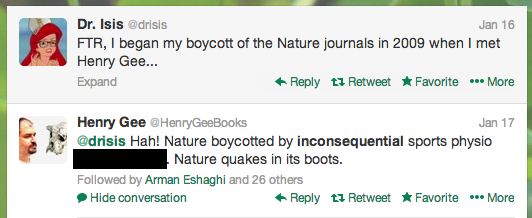
A couple of days ago on Twitter, Henry Gee, the senior editor of biological sciences at Nature, outed a widely-read, oft-shared, and sometimes controversial anonymous blogger, Dr. Isis. He took great glee in doing so because he didn't like some of her blog posts in which she called out some outrageous and sexist editorial decisions he had made (you may recall the awful "Womanspace" essay, described and eviscerated here by Dr. Isis), as well as her distaste for Nature’s bleak record regarding women in the sciences. The reaction in the scientific community online has been one of outrage that a senior, white, male took it upon himself to out a junior woman of color, and did so in such a publicly vindictive way, describing her as "inconsequential" and threatening on Twitter to "add (others) to the list" for daring to call him out for his boarish (at best) behavior (see Michael Eisen, co-founder of PLOS, condemn Gee here.).

Please do not dismiss this as "just happening online." Online (e.g. Twitter, blogs, Facebook, etc.) is *exactly* the place where important discussions about gender and color equity in the sciences occur on an hourly basis, it is *exactly* the place where junior and other marginalized scientists are finding a voice to share doubts and build power in a system that constantly knocks us down, and it is *exactly* the place where a Senior Editor at the science journal with the highest impact factor chose to publicly punish and damage an untenured woman of color who dared to challenge him.


As a biological anthropologist working toward tenure, a paper in Nature could “make” my career. I have as-yet-untenured colleagues at Ivies who get tsked-tsked for NOT submitting to Nature. The reverence for impact factors requires us to consider this the pinnacle of scientific publishing, at the same time that senior representatives of that very same journal with public platforms show absolutely no shame in trivializing our efforts as scientists or our very real struggles as outsiders in the Old White Boys Club. Struggles that make me feel like this a lot, and I actually have it pretty easy.

This continued outsider existence is what leads many to seek the clearly imperfect protection of an online pseudonym. Pseudonymity on the the internet has a long and defensible history, largely as protection of some kind, often against reprisals by employers. Sometimes as protection against cyber-stalking and sometimes real-life stalking and physical assault. But another reason is that it can offer protection against the clubbishness and bullying of privileged scholars with powers to hire, publish, grant funds. The power to deem one as a scientist of consequence. The power to refuse the pervasive poison that is their privilege and blindness. Henry Gee's outing of Dr. Isis clearly illustrates the continued vulnerability of women, people of color, and LGBTQ people speaking their truths and challenging Goliaths. Nature may well have a binder full of teh womenz (it’s so heavy, I hope they still have the strength to pat themselves on the back!), but they also got a million problems, most of which can be well visualized in a mirror, should they choose to look. 

Hahahahaha! I know, I know. That's not gonna happen. So, fine.  Nature, you are on my list. My list of overly inflated institutions that I've been taught to revere even when they've made it clear our kind isn't really welcome. I'm done. As long as you stand with Henry Gee and make no real efforts to change the climate for scientists like me, like Dr. Isis, like Danielle Lee, like millions of others, you won't be getting my papers (and trust me, I do some smoking hot, Nature-worthy science), you won't be getting my reverence. You don't get to push us around and have us thank you for it. 


Wednesday, December 4, 2013

American Anthropologist's "particular problem" with biological anthropology

"Singling out biological anthropologists as representing a “particular problem” reinforces the pervasive premise that sociocultural anthropology is normative anthropology, and the measure against which all other specialties are compared (and apparently fall short)."
http://www.anthropology-news.org/index.php/2013/12/04/american-anthropologists-particular-problem-with-biological-anthropology/

Thursday, September 5, 2013

Assistant Professorship, UNLV

The Department of Anthropology at the University of Nevada, Las Vegas (UNLV) invites applications for a tenure track Assistant Professor of Biological Anthropology. Expertise in paleoanthropology is preferred. The successful candidate will engage in theory-driven field research, and demonstrate evidence of effective teaching, of obtaining extramural funding, and of a strong record of scholarly publications. The candidate should synergize with other faculty focused on bioarchaeology, prehistoric archaeology, hunter-gatherers, and the evolution of human social behavior and nutrition. The Department offers BA, MA, and PhD degrees, and has research emphases in adaptive strategies; food and nutrition; childhood and parenting; and sexuality, gender, and identity. Applicants should be able to teach a range of courses, from an introductory course in Biological Anthropology to more advanced undergraduate and graduate classes. The successful candidate must have a PhD in hand by July 1, 2014. Review of applications begins on November 15 and continues until the position is filled. Submit a letter of interest, a detailed resume listing qualifications and experience, and the names, addresses, and telephone numbers of at least three professional references who may be contacted. Applicants should fully describe their qualifications and experience, with specific reference to each of the minimum and preferred qualifications because this is the information on which the initial review of materials will be based. The review of materials will begin November 15, and will continue until the position is filled. Materials should be addressed to Dr. Peter Gray, Search Committee Chair, and are to be submitted via on-line application at https://hrsearch.unlv.edu.  For assistance with UNLV’s on-line applicant portal, contact UNLV Employment Services at (702) 895-2894 or hrsearch@unlv.edu. Applicants of under-represented groups are encouraged to apply.

Saturday, May 4, 2013

Visiting Assistant Professorship, UNLV Anthropology

The Department of Anthropology at the University of Nevada, Las Vegas (UNLV) invites applications for a one-year Visiting Assistant Professorship. Expertise in biological anthropology is required, with more specific interests including paleoanthropology and skeletal biology. The Department offers BA, MA, and PhD degrees, and has research emphases in adaptive strategies; food and nutrition; childhood and parenting; and sexuality, gender, and identity. The successful candidate must have a PhD in hand by July 1, and be able to teach Introduction to Cultural Anthropology and Introduction to Physical Anthropology. There will also be an opportunity to teach a class drawing upon the applicant’s expertise. Review of applications begins on May 15 and continues until the position is filled. Submit letter of application, curriculum vitae, evidence of teaching excellence, and the contact information, including email addresses, for three references via an online application at http://jobs.unlv.edu/openings.html. For assistance with UNLV’s online applicant portal, contact UNLV Employment Services at (702) 895-2894 or hrsearch@unlv.edu. Applicants of under-represented groups are encouraged to apply. EEO/AA Educator and Employer.

Friday, May 3, 2013

Jill Scott, Student Liaison to the AAPA Executive Committee and BANDIT FB mod!


My name is Jill Scott and I am a PhD candidate in Anthropology at the University of Iowa (where I also received my MA). I went to the University of Illinois at Urbana-Champaign for my BA in Anthropology, and prior to that, I received my AA at McHenry County College in Crystal Lake, IL.

It is my pleasure to write this post as the current American Association of Physical Anthropologists Student Liaison to the Executive Committee. What this means is that I am the only student representative on the AAPA Executive Committee. While students make up a significant portion of the AAPA membership and presenters at each annual meeting (and by significant, I mean at least half), there is a dearth of student representation within the organization. The AAPA Executive Committee realizes this, and hence, wanted to increase the voice of students in the AAPA. As such, one of my first official acts was to create an AAPA ad hoc Student Committee, that is, a committee run by students, for students. Even if you are not a student representative or don’t serve on a committee, there are ways to get involved in the AAPA other than presenting. The reasons for students to get involved are many.

“If you want to assume a leadership position in the AAPA, start early.”
These words are not directly my own, but are paraphrased from a faculty advisor I heard tell this to her own students when encouraging them to attend the AAPA Business Meeting, and I think they’re particularly appropriate here. 

Yes, networking at the meetings is important, and something that we all hopefully already do. However, there are activities at the meetings (other than hitting the bar with our friends after a long day of talks and posters) that are also important to learning how the organization functions, which is useful for all members to know. The simplest way to get informed is to attend the AAPA Business Meeting. I myself never attended in the past because I thought it was some kind of “secret society” that only full (i.e., non-student) members were allowed to attend. After all, they vote on resolutions at the business meeting, right? Right, but I can tell you that as a student member, it’s YOUR duty to vote on these resolutions and proposals too! 

I am happy to report that this year I attended the AAPA Business Meeting after having been explicitly told that it’s open to ALL members. And I am even happier to report that I actually found it INTERESTING (then again, I am a huge nerd, but I hope that we all are!) At the business meeting, each member of the Executive Committee and all Committee Chairs give a very brief report of their activities over the past year. This includes a report from the AJPA and Yearbook editors (including some useful tips on how to get published in each), a recap of how much money was made at the AAPA Auction (which is useful to know because that money goes to fund OUR student awards), and brief reports from Wenner-Gren President, Leslie Aiello, and NSF Biological Anthropology Program Chair, Carolyn Ehardt. Both of their reports reflected the current statuses of their respective funding agencies along with some useful tips on how to get funded. In short, the business meeting is full of all kinds of benefits, but you have to be present to reap them!

For many of us in biological anthropology, the AAPA is our primary professional organization, yet you may have no idea how it actually operates (I didn’t until I began interacting with the Executive Committee over the past year). Unlike some of our “sister organizations” (e.g., the American Anthropological Association and the Society for American Archaeology), the AAPA has no permanent, paid staff. The AAPA is entirely volunteer-based, other than some of the work that we outsource (e.g., membership is managed in part by Allen Press- the website where you log in to become a member or renew membership). As such, I have learned that there are several AAPA committees on which one can serve. Presently, many committees are served only by full AAPA members, as is stipulated by the association bylaws, but there are opportunities for those of us who are still students as well.

I am here to tell you about some of the opportunities available to graduate (and undergraduate) students in the AAPA, some of which you may be aware of, some of which you may not unless you carefully read every word of the “Call for Papers” every year.

·         Attend the Business Meeting! Friday evening of the meetings.
·         AAPA Student Liaison to the Executive Committee: This position was started in 2012 and lasts for a 1 year term from one year’s meetings to the next (i.e., my official term runs from 2013–2014). The call for applications goes out in the annual “Call for Papers” and the applications for next year’s Student Liaison will be due September 15, 2013.
·         AAPA Student Committee: This was just founded at the meetings in Knoxville, so I’m not sure exactly what we’ll be doing yet, but Sarah Livengood (BAS Student Rep) and I have discussed holding a workshop of some sort at the 2014 AAPAs. If you are interested in serving on this committee and have ideas you’d like to see us accomplish, please contact me!
·         Reviewer for the Undergrad Research Symposium: For the last several years, the AAPA Committee on Diversity has hosted the Undergraduate Research Symposium on Wednesday evening prior to the Opening Reception. As part of this Symposium, graduate student volunteers review the undergraduate abstract submissions. Check the “Call for Papers” to find out how to volunteer to be a reviewer!
·         Career Development Committee Panel: Each year the Career Development Committee (CDC) hosts a panel on issues pertinent to students and early career bioanthropologists. This year’s session focused on tips for landing a job, next year is scheduled to discuss applying for grants, and other years the panel has discussed issues related to teaching and “non-traditional” jobs for physical anthropologists. I would highly recommend attending these panels!
·         PA WMN Luncheon/Happy Hour: Again for the past several years, the Physical Anthropology Women’s Mentoring Network (PA WMN) has hosted a luncheon (for which registration is required) for young females in the field to sit down and discuss important issues with more established women in the field. The PA WMN also hosts a happy hour open to all women in the field to come chat about issues faced by women in physical anthropology.
·         BANDIT Happy Hour: If you’re reading this blog post, you should already know that BANDIT holds a happy hour that students are welcome to attend to discuss issues pertinent to students and early career physical anthropologists!
·         Apply for Student Awards! The AAPA has a variety of student awards available for student research presentations (podium and poster), some of which are sponsored by or co-sponsored with the American Association for Anthropological Genetics, the American Association of Anatomists, and the Dental Anthropology Association. Even if you’re not presenting, you can still apply for funding to attend the meetings via the William S. Pollitzer Student Travel Award. This year, the AAPA awarded 43 Pollitzer Travel Awards and this number has only been increasing! Again, check the “Call for Papers” to see when applications for student awards are due each year!
·         Volunteer to Chair a Session: Remember when you register to present at the AAPAs and you’re asked if you’d be willing to chair a session? Well, yes, you can do this as a grad student! But remember, you have to be comfortable with stopping people at 15 minutes, including all the big wigs in the field, so if you’re not comfortable with this, this is not the position for you!

Opportunities for student involvement are ever increasing in the AAPA, so I hope that you will consider getting involved. Please feel free to get in touch with me if you have any additional questions, suggestions, or would like to volunteer for the Student Committee!

Tuesday, April 30, 2013

Sarah Livengood, BAS rep and BANDIT FB mod!

My name is Sarah V. Livengood and I am the current student representative for the Biological Anthropology Section (BAS) of the American Anthropological Association (AAA). I am a doctoral student at the University of Arkansas. I earned my MA at Georgia State University and my BA at the University of North Carolina at Greensboro. As a freshman I was lucky enough to attend the AAA conference with student government funding allocated to our anthropology club. The experience gave me the chance to see everything my discipline has to offer. It also provided me the opportunity to see what an academic conference actually is, and when it came time to present my research I was far less intimidated by the experience.

I did not attend the AAA meeting again until my first year as a graduate student. I became active in BAS accidently when I stumbled into the BAS board meeting. My advisor had encouraged me to attend the BAS business meeting, and I misread the program. My mistake became an opportunity when I was encouraged to throw my name in the hat for the student representative seat. Getting involved in the “business side of things” has been an eye-opening experience. Not only have I got to spend time with professional anthropologists that I admire, but I have also learned what keeps an association running, how they support their members, and the resources available to me as a student. 

I have found there are benefits to getting involved as a student. The AAA as a whole offers countless opportunities for students to be active in a professional organization, and the boost to your CV isn’t too shabby. You can find ways to get involved through sections and committees, and there is even a student section (National Association of Student Anthropologists). Biological anthropology students can benefit from all of these opportunities and gain a supportive network within the AAA. The Biological section has a business meeting and reception every year, sponsors several poster and paper sessions, and has a student paper/poster competition that includes recognition at the business meeting, a monetary prize, and publication in the BAS section of Anthropology News.

One of the biggest issues I face as BAS student representative is encouraging student participation in AAA, and helping students realize that there is a place for them and their research at the AAA conference. The AAA has provided me with countless opportunities to further my career, and the chance to meet and work with people I might never meet otherwise.  Attending any conference can be expensive, and I only made it to my first meeting with the support of my department and university. A lot of universities offer funding if you are presenting, but there are also options if you aren’t presenting. Your anthropology club is a great way to get a group of students together to help alleviate some of the costs through shared hotel rooms, transportation, etc. and a university sponsored organization can petition student governments to help fund educational trips. Also check out the variety of student awards offered by different sections of the AAA’s, some of these are travel related. And of course, contact your student representative if you have any questions!